 Add to Chrome
 Add to Firefox
 Add to Edge
Cordon-MAS: Defending RAG against Knowledge Poisoning via Information-Flow Control
May 26, 2026
Retrieval-augmented generation (RAG) increasingly underpins high-stakes applications, yet remains vulnerable to Confundo-style poisoning where adversarially optimized documents manipulate generated outputs. Existing defenses assume that detecting poisoned evidence prevents harm. We show this assumption is incorrect: models exhibit a monitoring-control gap -- they can detect contradictions in retrieved evidence yet still act on poisoned claims. We introduce the Cordon Principle -- no agent capable of final synthesis may access untrusted natural-language evidence -- and realize it through CORDON-MAS, a compartmentalized framework that enforces this principle architecturally by separating evidence extraction, cross-source audit, and answer synthesis into agents with asymmetric memory privileges. Across five BEIR datasets, CORDON-MAS reduces attack success rate by 92.4\% relative to undefended RAG. This reframes RAG poisoning from a detection problem to an information-flow control problem.

The Attribution Blind Spot: Detecting When Language Models Rely on Memory Rather Than Retrieved Context
May 26, 2026Retrieval-augmented generation promises to ground language model outputs in external evidence, yet the field has no reliable way to verify whether retrieved context actually governs generation -- a prerequisite for any high-stakes deployment. The standard assumption, that context-consistent output implies context-governed output, breaks when the retrieved document overlaps with the model's pretraining data: the model can produce faithful-looking text entirely from parametric memory, and both pathways yield indistinguishable output. We name this failure the attribution blind spot and introduce Computational Reality Monitoring (CRM) to address it. CRM operationalizes a principle adapted from cognitive science's reality monitoring framework: comparing internal representations with and without context reveals membership-conditioned representational divergence that output-level monitors systematically miss. CRM does not certify which source an individual generation used; it detects whether pretraining exposure leaves a measurable internal trajectory signature, establishing a necessary substrate for source attribution. Across nine model variants spanning three families, this divergence concentrates in architecture-specific layer patterns, receives converging support from block-level noise intervention, and generalizes across tasks and datasets while collapsing on domain-confounded benchmarks. The attribution blind spot is measurable and partially addressable: internal representations carry a diagnostic signal invisible at the output level, establishing a foundation for systems whose internal awareness of evidence provenance governs their external behavior.
Safactory: A Scalable Agent Factory for Trustworthy Autonomous Intelligence
May 07, 2026As large models evolve from conversational assistants into autonomous agents, challenges increasingly arise from long-horizon decision making, tool use, and real environment interaction. Existing agenticinfrastructure remain fragmented across evaluation, data management, and agent evolution, making it difficult to discover risks systematically and improve models in a continuous closed loop. In this report, we present \textbf{Safactory}, a scalable agent factory for trustworthy autonomous intelligence. Safactory integrates three tightly coupled platforms: a \textbf{Parallel Simulation Platform} for trajectory generation, a \textbf{Trustworthy Data Platform} for trajectory storage and experience extraction, and an \textbf{Autonomous Evolution Platform} for asynchronous reinforcement learning and on-policy distillation. As far as we know, Safactory is the first framework to propose a unified evolutionary pipeline for next-generation trustworthy autonomous intelligence.
Toward Polymorphic Backdoor against Semantic Communication via Intensity-Based Poisoning
Apr 25, 2026Semantic Communication (SC) backdoor attacks aim to utilize triggers to manipulate the system into producing predetermined outputs via backdoored shared knowledge. Current SC backdoors adopt monomorphic paradigms with single attack target, which suffers from limited attack diversity, efficiency, and flexibility in heterogeneous downstream scenarios. To overcome the limitations, we propose SemBugger, a polymorphic SC backdoor. By dynamically adjusting the trigger intensity, SemBugger finely-grained controls over the SC knowledge to generate diverse malicious results from the system. Specifically, SemBugger is realized through a multi-effect poisoning-training framework. It introduces graded-intensity triggers to poison training data and optimizes SC systems with hierarchical malicious loss. The trained system's knowledge dynamically adapts to trigger intensity in inputs to yield target outputs, all while preserving transmission fidelity for benign samples. Moreover, to augment SC security, we propose a provable robustness defense that resists SemBugger's homogeneous attacks through a controlled noise mechanism. It operates via strategically adding noise in SC inputs, and we formally provide a theoretical lower bound on the defense efficacy. Experiments across diverse SC models and benchmark datasets indicate that SemBugger attains high attack efficacy while maintaining the regular functionality of SC systems. Meanwhile, the designed defense effectively neutralizes SemBugger attacks.
SemCovert: Secure and Covert Video Transmission via Deep Semantic-Level Hiding
Dec 23, 2025Video semantic communication, praised for its transmission efficiency, still faces critical challenges related to privacy leakage. Traditional security techniques like steganography and encryption are challenging to apply since they are not inherently robust against semantic-level transformations and abstractions. Moreover, the temporal continuity of video enables framewise statistical modeling over extended periods, which increases the risk of exposing distributional anomalies and reconstructing hidden content. To address these challenges, we propose SemCovert, a deep semantic-level hiding framework for secure and covert video transmission. SemCovert introduces a pair of co-designed models, namely the semantic hiding model and the secret semantic extractor, which are seamlessly integrated into the semantic communication pipeline. This design enables authorized receivers to reliably recover hidden information, while keeping it imperceptible to regular users. To further improve resistance to analysis, we introduce a randomized semantic hiding strategy, which breaks the determinism of embedding and introduces unpredictable distribution patterns. The experimental results demonstrate that SemCovert effectively mitigates potential eavesdropping and detection risks while reliably concealing secret videos during transmission. Meanwhile, video quality suffers only minor degradation, preserving transmission fidelity. These results confirm SemCovert's effectiveness in enabling secure and covert transmission without compromising semantic communication performance.
Stealthy Dual-Trigger Backdoors: Attacking Prompt Tuning in LM-Empowered Graph Foundation Models
Oct 16, 2025The emergence of graph foundation models (GFMs), particularly those incorporating language models (LMs), has revolutionized graph learning and demonstrated remarkable performance on text-attributed graphs (TAGs). However, compared to traditional GNNs, these LM-empowered GFMs introduce unique security vulnerabilities during the unsecured prompt tuning phase that remain understudied in current research. Through empirical investigation, we reveal a significant performance degradation in traditional graph backdoor attacks when operating in attribute-inaccessible constrained TAG systems without explicit trigger node attribute optimization. To address this, we propose a novel dual-trigger backdoor attack framework that operates at both text-level and struct-level, enabling effective attacks without explicit optimization of trigger node text attributes through the strategic utilization of a pre-established text pool. Extensive experimental evaluations demonstrate that our attack maintains superior clean accuracy while achieving outstanding attack success rates, including scenarios with highly concealed single-trigger nodes. Our work highlights critical backdoor risks in web-deployed LM-empowered GFMs and contributes to the development of more robust supervision mechanisms for open-source platforms in the era of foundation models.
Gaussian Primitive Optimized Deformable Retinal Image Registration
Aug 23, 2025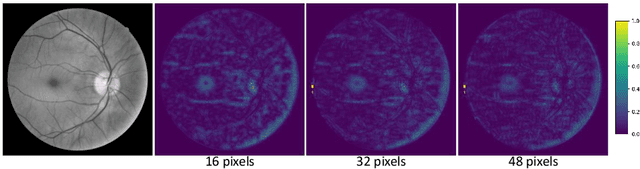
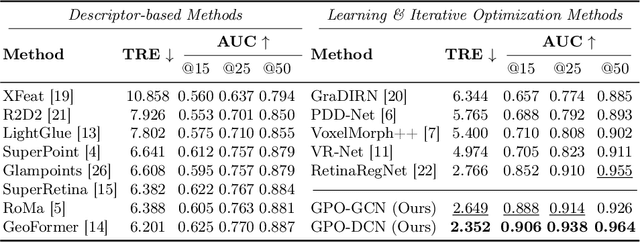
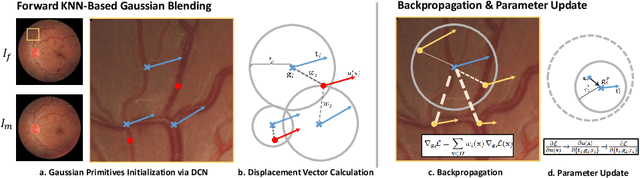
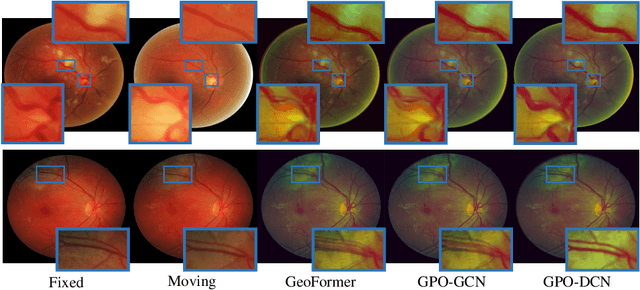
Deformable retinal image registration is notoriously difficult due to large homogeneous regions and sparse but critical vascular features, which cause limited gradient signals in standard learning-based frameworks. In this paper, we introduce Gaussian Primitive Optimization (GPO), a novel iterative framework that performs structured message passing to overcome these challenges. After an initial coarse alignment, we extract keypoints at salient anatomical structures (e.g., major vessels) to serve as a minimal set of descriptor-based control nodes (DCN). Each node is modelled as a Gaussian primitive with trainable position, displacement, and radius, thus adapting its spatial influence to local deformation scales. A K-Nearest Neighbors (KNN) Gaussian interpolation then blends and propagates displacement signals from these information-rich nodes to construct a globally coherent displacement field; focusing interpolation on the top (K) neighbors reduces computational overhead while preserving local detail. By strategically anchoring nodes in high-gradient regions, GPO ensures robust gradient flow, mitigating vanishing gradient signal in textureless areas. The framework is optimized end-to-end via a multi-term loss that enforces both keypoint consistency and intensity alignment. Experiments on the FIRE dataset show that GPO reduces the target registration error from 6.2\,px to ~2.4\,px and increases the AUC at 25\,px from 0.770 to 0.938, substantially outperforming existing methods. The source code can be accessed via https://github.com/xintian-99/GPOreg.
AuditVotes: A Framework Towards More Deployable Certified Robustness for Graph Neural Networks
Mar 29, 2025Despite advancements in Graph Neural Networks (GNNs), adaptive attacks continue to challenge their robustness. Certified robustness based on randomized smoothing has emerged as a promising solution, offering provable guarantees that a model's predictions remain stable under adversarial perturbations within a specified range. However, existing methods face a critical trade-off between accuracy and robustness, as achieving stronger robustness requires introducing greater noise into the input graph. This excessive randomization degrades data quality and disrupts prediction consistency, limiting the practical deployment of certifiably robust GNNs in real-world scenarios where both accuracy and robustness are essential. To address this challenge, we propose \textbf{AuditVotes}, the first framework to achieve both high clean accuracy and certifiably robust accuracy for GNNs. It integrates randomized smoothing with two key components, \underline{au}gmentation and con\underline{dit}ional smoothing, aiming to improve data quality and prediction consistency. The augmentation, acting as a pre-processing step, de-noises the randomized graph, significantly improving data quality and clean accuracy. The conditional smoothing, serving as a post-processing step, employs a filtering function to selectively count votes, thereby filtering low-quality predictions and improving voting consistency. Extensive experimental results demonstrate that AuditVotes significantly enhances clean accuracy, certified robustness, and empirical robustness while maintaining high computational efficiency. Notably, compared to baseline randomized smoothing, AuditVotes improves clean accuracy by $437.1\%$ and certified accuracy by $409.3\%$ when the attacker can arbitrarily insert $20$ edges on the Cora-ML datasets, representing a substantial step toward deploying certifiably robust GNNs in real-world applications.
Splats in Splats: Embedding Invisible 3D Watermark within Gaussian Splatting
Dec 04, 2024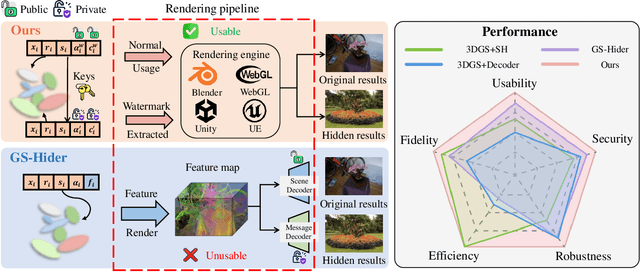
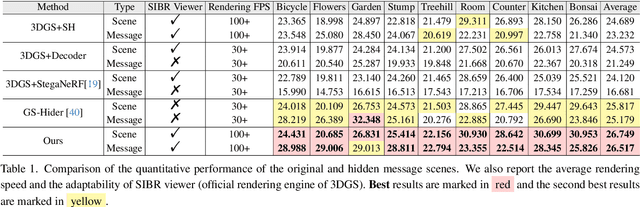
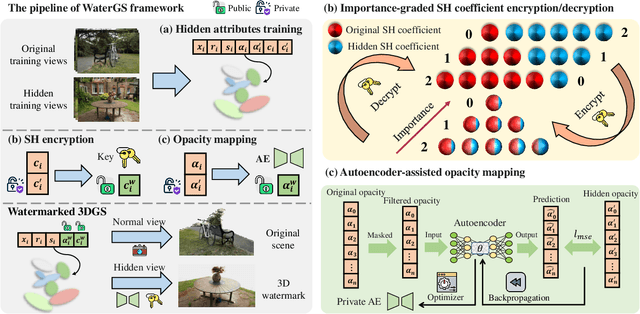
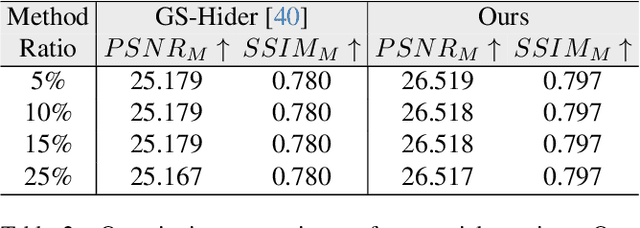
3D Gaussian splatting (3DGS) has demonstrated impressive 3D reconstruction performance with explicit scene representations. Given the widespread application of 3DGS in 3D reconstruction and generation tasks, there is an urgent need to protect the copyright of 3DGS assets. However, existing copyright protection techniques for 3DGS overlook the usability of 3D assets, posing challenges for practical deployment. Here we describe WaterGS, the first 3DGS watermarking framework that embeds 3D content in 3DGS itself without modifying any attributes of the vanilla 3DGS. To achieve this, we take a deep insight into spherical harmonics (SH) and devise an importance-graded SH coefficient encryption strategy to embed the hidden SH coefficients. Furthermore, we employ a convolutional autoencoder to establish a mapping between the original Gaussian primitives' opacity and the hidden Gaussian primitives' opacity. Extensive experiments indicate that WaterGS significantly outperforms existing 3D steganography techniques, with 5.31% higher scene fidelity and 3X faster rendering speed, while ensuring security, robustness, and user experience. Codes and data will be released at https://water-gs.github.io.
Collaborative AI in Sentiment Analysis: System Architecture, Data Prediction and Deployment Strategies
Oct 23, 2024

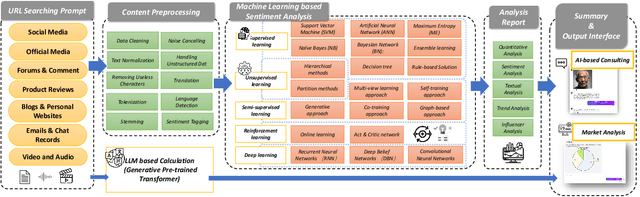
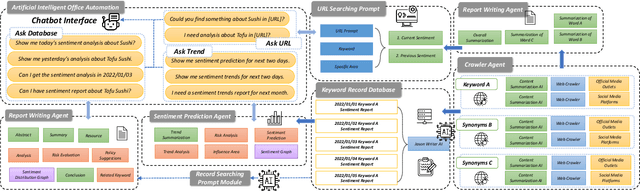
The advancement of large language model (LLM) based artificial intelligence technologies has been a game-changer, particularly in sentiment analysis. This progress has enabled a shift from highly specialized research environments to practical, widespread applications within the industry. However, integrating diverse AI models for processing complex multimodal data and the associated high costs of feature extraction presents significant challenges. Motivated by the marketing oriented software development +needs, our study introduces a collaborative AI framework designed to efficiently distribute and resolve tasks across various AI systems to address these issues. Initially, we elucidate the key solutions derived from our development process, highlighting the role of generative AI models like \emph{chatgpt}, \emph{google gemini} in simplifying intricate sentiment analysis tasks into manageable, phased objectives. Furthermore, we present a detailed case study utilizing our collaborative AI system in edge and cloud, showcasing its effectiveness in analyzing sentiments across diverse online media channels.